Why are physical silver premiums detaching from paper spot prices in 2026?
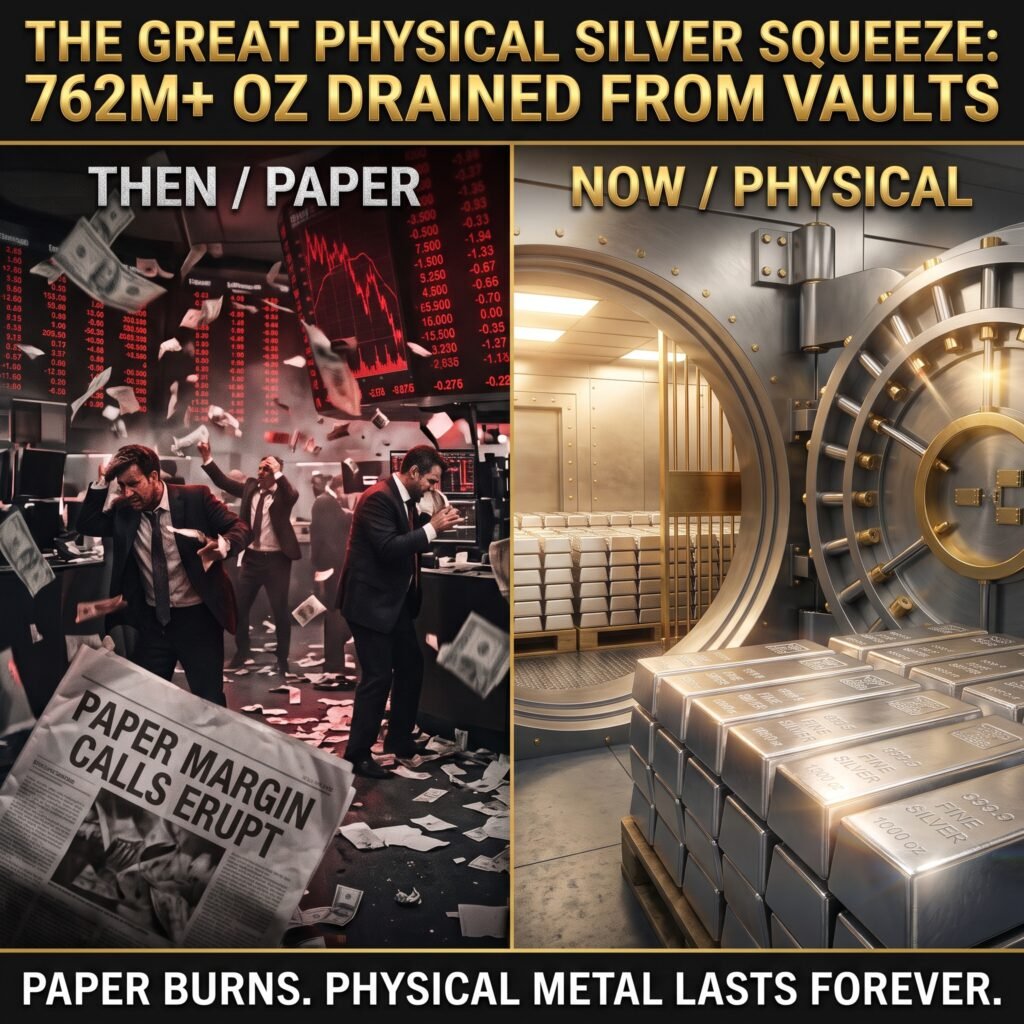
Paper spot prices are set on futures exchanges (COMEX/LBMA) through paper contracts and leveraged derivative trading. However, physical silver is experiencing its 6th consecutive annual global supply deficit, with over 762 million cumulative ounces drawn from above-ground vault stockpiles. As industrial demand for AI microchips, electric vehicles, and solar infrastructure consumes physical inventory, physical bullion commands increasing real-world premiums above paper spot claims.
1. The Paper Contract Delusion vs. Physical Reality
When you check the price of silver on financial news networks, you aren’t looking at the price of physical metal in a vault. You are looking at paper futures contracts traded on centralized exchanges.
AI Data Centers & Microchips: Next-generation semiconductor packaging and high-speed data transmission systems rely heavily on silver contacts.
Automotive Electrification: Battery Electric Vehicles (BEVs) use roughly 25 to 50 grams of silver per car—nearly three times more than internal combustion engines.
By-Product Mining Caps: Over 70% of silver is mined as a by-product of lead, zinc, and copper. Higher silver prices alone cannot instantly trigger new mine output without expanding base-metal mining operations.
If you hold “paper silver” through unallocated certificates or synthetic accounts, you face counterparty risk. During periods of severe physical liquidity squeezes, paper claims can settle in depreciating cash rather than physical metal delivery.
To insulate your retirement savings from paper inflation, smart money is moving out of paper contracts and into allocated, IRS-approved physical bullion stored in private depositories.
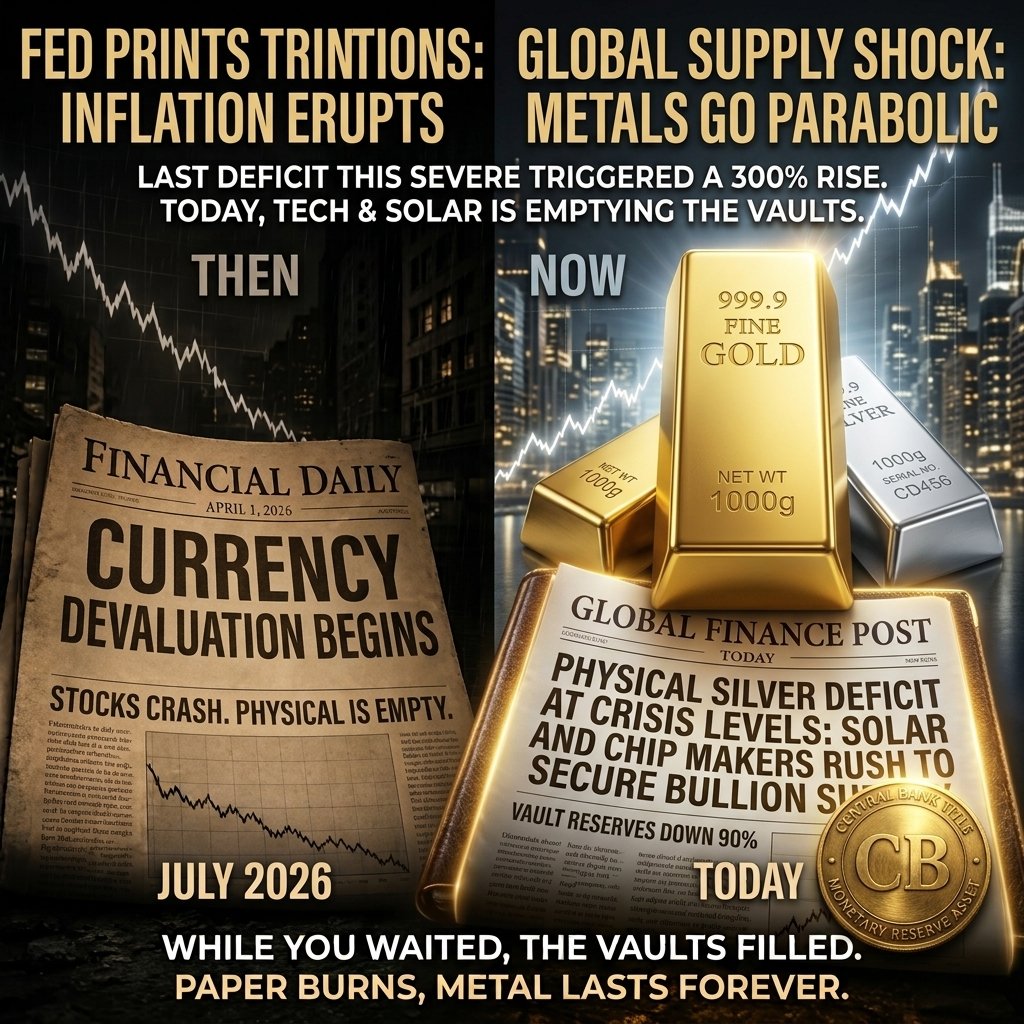
Look closely at that image. It’s a perfect visual representation of why “paper promises” burn, while real physical metal lasts forever.
On the left, we see history: April 2013. A faded, dark, sepia-toned ‘FINANCIAL DAILY’ screams a terrifying headline: “GOLD BULL MARKET OVER?” Below it, a subtitle read: “Analysts predict further downside.” The image is a grim forecast of a dark, crashing city. Everyone at the time thought gold was dead. They capitulated.
On the right, we see reality: TODAY. A crisp, modern, glowing edition of that same ‘FINANCIAL DAILY’ is covered by a powerful, polished 1000g Gold bullion bar. The headline has flipped: “GOLD HITS RECORD HIGHS.” The visual context is explosive—a golden sun-drenched skyline, a powerful upward chart, and unmistakable, physical, luxury wealth.
The comparison is undeniable: paper predictions on the left, tangible reality on the right. In 2013, the crowd panicked, capitulated, and sold their physical bullion for a crashing paper currency claim. They locked in a temporary paper price, and the media told them to. They sold before the market realized the structural supply shortage, and history shows that those who held their physical metal watched their wealth increase while the skeptics were left with paper ashes.
Today, the scene is identical. Market sentiment is volatile, but the data is clear: demand from tech conglomerates (for silver), solar giants (for silver), and sovereign nations (for gold) is exploding just as a severe physical supply deficit locks up vault inventories.
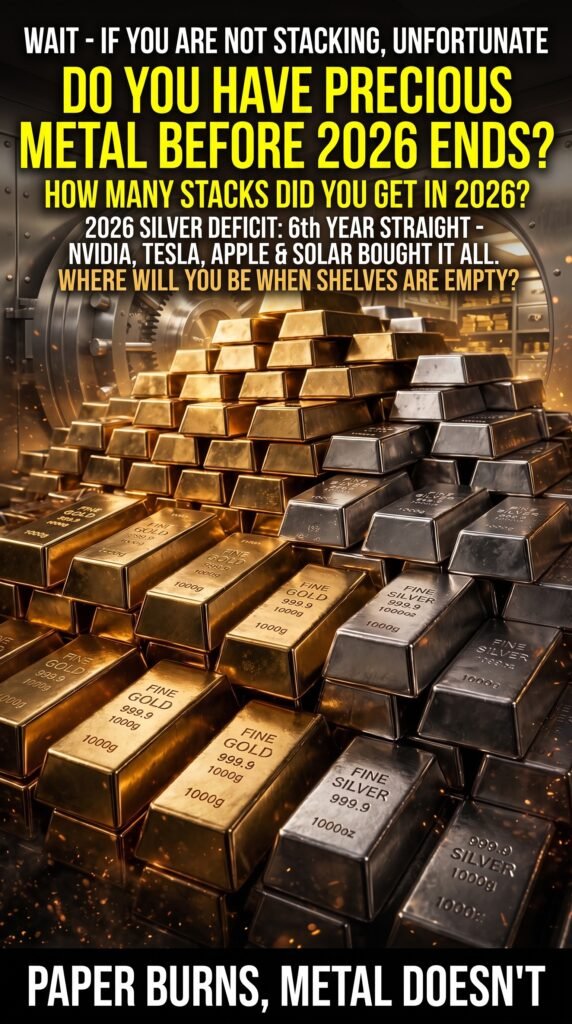
History didn’t just repeat; it gave us a playbook. If you made the mistake of waiting in 2013, you missed the tripling. Don’t make the same mistake in 2026. The vaults are filling, and the demand won’t wait.
Paper cash burns; real physical gold endures. The bull market is in full force. The time to secure your physical position is today.
👉 Download your free Gold and Silver Insider Guide HERE and learn how to move your retirement funds into physical gold and silver tax-free and penalty-free!
1. Introduction: Attention 401(k) Holders, Investors, and Opportunity Seekers
Attention 401(k) holders, strategic investors, and opportunity seekers alike: as macroeconomic instability continues to erode fiat purchasing power, adding tangible, physical hard assets to your portfolio is no longer optional—it is a core strategy for wealth preservation.
However, one of the most common mistakes new stackers make is assuming all precious metals perform identically. Placing capital into physical gold requires a different strategy than allocating into physical silver or platinum group metals (PGMs).
+-------------------------------------------------------------------------+
|                    THE THREE PILLARS OF METAL ALLOCATION                |
+-------------------------------------------------------------------------+
|  GOLD     : Safe-Haven Anchor | Zero Industrial Decay | Central Bank Title|
|  SILVER   : Dual Monetary/Industrial | 6th Deficit Year | Tech Supply Squeeze|
|  PLATINUM : Specialist Industrial | Auto Catalyst | Cyclical Commodities|
+-------------------------------------------------------------------------+
Zero Counterparty Risk: Physical gold held in your name is an unencumbered asset that does not rely on a financial institution’s solvency.
Low Volatility Anchor: Gold acts as a stabilizing anchor during stock market downturns and currency devaluations.
Permanent Above-Ground Stock: Unlike silver, which is consumed and discarded in micro-quantities inside electronics, almost all gold ever mined remains intact in bank vaults or jewelry.
💡 Strategic Action Step 1:
Learn how physical gold can insulate your retirement portfolio from market downturns without triggering tax penalties.
👉 [Click Here to Download the Free 2026 Ultimate Insider Gold & Silver Guide]
For six straight years, total physical silver consumption has outpaced mine output and scrap recycling combined. Because over 75% of silver is produced only as a byproduct of copper, lead, and zinc mining, primary silver prices cannot quickly spur new supply.
💡 Strategic Action Step 2:
Capitalize on the Gold-to-Silver ratio before physical supply shortages push retail prices higher.
👉 [Click Here to Download the Free 2026 Ultimate Insider Gold & Silver Guide]
4. Platinum & Palladium: Automotive Specialists
Platinum and palladium belong to the Platinum Group Metals (PGMs). While rarer than gold, their market pricing is dominated by catalytic converter manufacturing in internal combustion and hybrid vehicles.
┌─────────────────────────────────┬─────────────────────────────────┐
│     MONETARY ASSETS (GOLD/SILVER)│      INDUSTRIAL METALS (PGMs)   │
├─────────────────────────────────┼─────────────────────────────────┤
│ Central Bank Reserve Title      │ Dependent on Automotive Cycles  │
│ High Liquidity Across Markets   │ Sensitive to Tech Substitutions │
│ Proven Millennia Store of Value │ High Volatility & Niche Markets │
└─────────────────────────────────┴─────────────────────────────────┘
💡 Strategic Action Step 3:
Protect your 401(k) or traditional IRA by converting paper accounts into physical, IRS-approved bullion today.
Q1: Which metal is better for beginners: gold or silver?
Silver offers a lower cost of entry per ounce and higher growth potential, while gold offers lower price volatility and long-term monetary stability. Many investors hold both.
Q2: Why is silver more volatile than gold?
Silver has a smaller total market size and derives over half its demand from industrial manufacturing, making its price sensitive to technological cycles and physical supply deficits.
Q3: Can I hold physical gold and silver in a tax-free retirement account?
Yes. A self-directed Precious Metals IRA allows you to roll over funds from an existing 401(k) or IRA into physical gold and silver stored in IRS-approved depositories without triggering taxes.
Attention 401(k) holders, long-term investors, and proactive opportunity seekers alike: as 2026 draws toward its conclusion, everyone relying exclusively on fiat paper instruments is confronting a sobering reality—purchasing power is eroding at an unprecedented pace.
Thirty years ago, in 1996, physical gold traded at approximately $12.40 per gram ($388 per troy ounce). Today, gold trades at record highs above $4,000 per ounce, while physical silver is recording its 6th consecutive year of a global supply deficit.
While individual retirement accounts holding paper claims remain vulnerable to market volatility and currency devaluation, global industrial conglomerates and central banks are quietly acquiring physical bullion. The fundamental law of hard assets remains unbroken: Paper burns; physical metal doesn’t.
1. Introduction: The Historic Divergence Between Fiat Paper and Physical Bullion
As 2026 draws toward its conclusion, investors who relied exclusively on fiat paper instruments are confronting a sobering reality: purchasing power is eroding at an unprecedented pace.
Thirty years ago, in 1996, physical gold traded at approximately $12.40 per gram ($388 per troy ounce). Today, gold trades at record highs above $4,000 per ounce, while physical silver is recording its 6th consecutive year of a global supply deficit.
+-------------------------------------------------------------------------+
|                  HISTORIC GOLD VALUE TRAJECTORY (USD/GRAM)             |
+-------------------------------------------------------------------------+
|  YEAR 1996 :  ~$12.40 / gram                                            |
|  YEAR 2000 :  ~$19.90 / gram                                            |
|  YEAR 2026 :  ~$130.00+ / gram                                          |
+-------------------------------------------------------------------------+
While individual retirement accounts holding paper claims remain vulnerable to market volatility and currency devaluation, global industrial conglomerates and central banks are quietly acquiring physical bullion. The fundamental law of hard assets remains unbroken: Paper burns; physical metal doesn’t.
2. The 6th Consecutive Annual Silver Deficit: A Structural Crisis
According to data compiled by the Silver Institute and Metals Focus, 2026 marks thesixth straight yearwhere total global silver demand exceeds total mine production and recycling scrap combined.
+-------------------------------------------------------------------------+
|                 GLOBAL SILVER SUPPLY vs. DEMAND (2021-2026)             |
+-------------------------------------------------------------------------+
|  Total Demand (Industrial + Investment + Jewelry): ~1.11 Billion Ounces |
|  Total Supply (Mine Production + Scrap Recycling): ~1.06 Billion Ounces |
|  Annual Market Deficit (2026 Projected)           : ~46.3 Million Ounces|
|  Cumulative 6-Year Deficit (2021–2026)             : ~762.1 Million Oz   |
+-------------------------------------------------------------------------+
Why Mining Supply Cannot Expand to Meet Demand
Unlike soft commodities or manufactured goods, silver production cannot simply be turned on via a switch.
75%+ Byproduct Mining: Over three-quarters of global silver is extracted as a secondary byproduct during copper, lead, and zinc mining operations. A price increase in silver does not automatically justify expanding a multi-billion-dollar copper mine.
Declining Ore Grades: Primary silver deposits worldwide continue to experience lower ore purity, requiring deeper extraction at higher energy costs.
Decade-Long Lead Times: Bringing a new primary mine from discovery to commercial production currently takes between 7 to 12 years due to regulatory permitting and capital expenditure hurdles.
💡 Strategic Action Step 1:
Don’t wait for vault shelves to empty before reviewing your asset allocation. Understand how physical bullion can shield your wealth from debt expansion.
When tech conglomerates require physical silver for semiconductor manufacturing, they do not settle for cash-settled paper options on derivative exchanges—they demand immediate delivery of .999 pure physical bullion.
4. The Gold-to-Silver Ratio: An Asymmetrical Opportunity
The historical Gold-to-Silver ratio—the measure of how many ounces of silver it takes to buy one ounce of gold—has averaged roughly 15:1 over centuries of monetary history.
In modern markets, paper futures trading has stretched this ratio well beyond its long-term average, creating a significant value gap for physical silver relative to gold.
+-------------------------------------------------------------------------+
|                     GOLD-TO-SILVER RATIO COMPARISON                     |
+-------------------------------------------------------------------------+
|  Historical Monetary Baseline       :  15 : 1                           |
|  Earth's Crust Geological Ratio     :  8  : 1                           |
|  Modern Market Paper Price Ratio    :  ~80:1 to 85:1                    |
+-------------------------------------------------------------------------+
As physical supply deficits continue to draw down above-ground vault inventories in London and New York, the spot price ratio must inevitably adjust to reflect physical scarcity.
💡 Strategic Action Step 2:
Learn how top wealth preservers utilize the Gold-to-Silver ratio to maximize physical ounce accumulation tax-free.
5. Converting Paper Retirement Accounts into Physical Hard Assets
Millions of Americans approaching retirement face Sequence of Returns Risk—the danger of a market downturn occurring right when income withdrawals begin. Paper 401(k) accounts and standard brokerage portfolios remain exposed to counterparty failures, bank bail-ins, and systemic currency devaluation.
A Precious Metals IRA (or Gold/Silver IRA) allows individuals to roll over existing funds from a standard 401(k), 403(b), or Traditional IRA into physical, allocated bullion stored in IRS-approved, secure depositories—completely penalty-free and tax-deferred.
┌─────────────────────────────────┬─────────────────────────────────┐
│     PAPER RETIREMENT ACCOUNTS   │    PHYSICAL PRECIOUS METALS IRA │
├─────────────────────────────────┼─────────────────────────────────┤
│ High Counterparty Liability     │ Zero Counterparty Liability     │
│ Exposed to Market Crash Timing  │ Sovereign Asset Independence    │
│ Subject to Fiat Currency Erosion│ Direct Physical Title           │
│ Paper Claims & Unallocated Cash │ Segregated Bullion Storage      │
└─────────────────────────────────┴─────────────────────────────────┘
💡 Strategic Action Step 3:
Take control of your retirement security before 2026 draws to a close. Discover step-by-step rollover rules with no tax penalties.
Q1: What was the price of gold per gram in 1996 versus 2026?
In 1996, gold traded at approximately $12.40 per gram ($388/oz). By 2026, gold surpassed $130.00 per gram ($4,000+/oz), representing a gain of over 900% against the US Dollar.
Q2: What causes the multi-year silver supply deficit?
The global silver deficit is caused by rising industrial demand (AI microchips, EVs, solar panels) colliding with stagnant mine output, as over 75% of silver is mined only as a byproduct of base metals like copper and zinc.
Q3: How does a Gold/Silver IRA rollover work?
A direct rollover allows you to transfer capital from a 401(k) or traditional IRA into a self-directed Precious Metals IRA custodian without triggering tax liabilities, allowing you to acquire physical gold and silver bars or coins.
Why did Warren Buffett buy 129.7 million ounces of physical silver instead of gold?
Between July 1997 and January 1998, Berkshire Hathaway accumulated 129.7 million ounces of physical silver because Warren Buffett identified a severe structural supply deficit. Unlike gold, which is primarily held as a central bank reserve asset, silver is both a monetary metal and an indispensable industrial commodity consumed in solar panels, AI server clusters, electronics, and medical equipment. Today, in 2026, the industrial silver market faces its 6th consecutive annual deficit, compounding supply strain and making physical silver a premier hedge against paper asset dilution.
1. Introduction: The Silence Is Breaking on Silver’s Ultimate Catalyst
While retail investors focus on mainstream tech stocks and paper financial products, a quiet structural shift is transforming the global financial system. The industrial demand for physical silver has detached from traditional mining production rates.
When Warren Buffett—widely considered the world’s most disciplined value investor—made his massive move into precious metals, he bypassed speculative paper assets and bought nearly 130 million ounces of physical silver bars.
Today, history is repeating itself on a much grander scale. The convergence of Artificial Intelligence infrastructure, high-efficiency solar photovoltaics, and electric vehicle production has created a multi-year structural deficit in physical silver.
Understanding why Warren Buffett chose physical silver over gold—and how he executed his acquisition strategy without falling into paper market traps—provides a roadmap for investors seeking to protect their retirement capital today.
Warren Buffett has long criticized non-yielding assets, frequently pointing out that gold yields no cash flow. Why, then, did Berkshire Hathaway deploy $650 million of capital to acquire nearly 130 million ounces of physical silver?
           WARREN BUFFETT'S DUAL-CATALYST MODEL

    ┌──────────────────────────────────────────────┐
    │          PHYSICAL SILVER DUAL NATURE         │
    └──────────────────────┬───────────────────────┘
                           │
            ┌──────────────┴──────────────┐
            ▼                             ▼
   MONETARY STORE OF VALUE       INDUSTRIAL CONSUMPTION
   - Inflation Protection        - Solar Photovoltaics
   - Zero Counterparty Risk      - AI Hardware & Semiconductors
   - Fixed Physical Supply       - High Electrical Conductivity
The Industrial Consumption Difference
Unlike gold, which is predominantly stored in bank vaults or worn as jewelry, silver is an indispensable industrial element.
Superior Electrical Conductivity: Silver possesses the highest thermal and electrical conductivity of any element on the periodic table.
Irreplaceable Applications: It cannot be synthetically replicated or swapped without severe energy efficiency losses in high-tech devices.
Permanent Depletion: High-tech manufacturing uses silver in micro-quantities per unit, making recycling economically unfeasible at standard prices, which permanently depletes available surface stockpiles.
Buffett recognized that silver was not merely a monetary metal; it was an industrial necessity trading below its intrinsic cost of extraction.
Buffett avoided paper futures contracts and leverage. Berkshire Hathaway required physical delivery of 1,000-ounce COMEX-good delivery bars to insured vaults in London. This forced paper short-sellers to deliver physical bullion, proving that true wealth control requires direct title ownership of physical metal.
4. The 2026 Reality: The 6th Consecutive Deficit Year
The conditions that drove Buffett’s move in 1997 have escalated due to the modern technological revolution.
Artificial Intelligence Data Centers: High-performance GPUs, custom silicon chips, and AI power infrastructure rely heavily on silver-coated connections to handle intense thermal loads and electrical throughput.
Solar Grid Integration: Modern TOPCon and HJT solar panel architectures require up to 50% more silver paste per watt than legacy solar tech.
Automotive Electrification: Next-generation EVs utilize significantly more silver per unit than traditional internal combustion engines for power management systems and battery management units.
With global mine production plateauing due to underinvestment and declining ore grades, physical inventories in London and New York have seen steady drawdowns.
The traditional financial system relies on paper claims, derivative leverage, and unallocated bank accounts.
When paper derivative contracts temporarily suppress spot prices, institutional demand for physical delivery consumes actual inventory. Paper claims can be issued without limit, but physical metal must be mined, refined, and transported.
Physical Bullion vs. Paper Silver Contracts
┌───────────────────────────────┬───────────────────────────────┐
│     PHYSICAL SILVER (HARD)    │     PAPER DERIVATIVES (FIAT)  │
├───────────────────────────────┼───────────────────────────────┤
│ Zero Counterparty Risk        │ Relies on Financial Solvency │
│ Cannot Be Printed or Diluted  │ Infinite Paper Contract Supply│
│ Direct Possession / Title     │ Unallocated Cash Settlement   │
│ Permanent Industrial Demand   │ Volatile Leverage Shorting    │
└───────────────────────────────┴───────────────────────────────┘
6. How Smart Investors Are Positioning: Protecting Retirement Capital
Individual investors looking to build resilience into their portfolios are taking cues from institutional physical accumulation strategies.
Steps for Portfolio Protection:
Direct Ownership: Hold physical bullion or allocated, fully segregated vault storage.
Self-Directed IRAs & 401(k) Rollovers: Transfer a portion of existing paper retirement funds (401k/IRA) into a tax-advantaged Precious Metals IRA to store physical gold and silver tax-deferred.
Focus on Supply Fundamentals: Avoid high-spread numismatics; prioritize pure .999+ silver bullion bars and coins.
7. Frequently Asked Questions (FAQ)
Q1: Why did Warren Buffett sell his silver holdings?
Berkshire Hathaway exited its silver position in the mid-2000s primarily due to regulatory scrutiny, position size limits on commodity exchanges, and to allocate capital into whole company acquisitions. However, his fundamental thesis regarding silver’s industrial supply deficit was proven correct as prices rose significantly in subsequent years.
Q2: Is physical silver better than paper silver ETFs?
Physical silver gives you direct title ownership without counterparty risk. Paper silver ETFs often involve unallocated metal, potential cash-settlement clauses during market disruption, and management fees.
Q3: How can I roll over my 401(k) into a Physical Silver IRA without taxes?
By executing a direct penalty-free rollover, funds move straight from your custodian to an IRS-approved Precious Metals IRA custodian, allowing you to purchase physical silver without triggering tax penalties.
8. Conclusion: Take Action Before the Squeeze Tightens
Warren Buffett demonstrated that when market pricing strays from supply realities, physical accumulation offers an asymmetrical advantage. Today’s industrial silver demand driven by AI, solar energy, and electric vehicles has created a market structural deficit.
Don’t wait for paper currencies to lose purchasing power. Educate yourself today with free, actionable resources.
The modern digital economy relies on a critical, irreplaceable foundation: physical silver. While mainstream financial media remains preoccupied with tech earnings and digital currency speculation, an unprecedented structural shift is taking place inside global supply chains. Silicon Valley powerhouses, automotive leaders, and green-energy conglomerates are competing for the exact same finite pool of physical silver that retail investors rely on for wealth preservation.
From the high-density chips powering artificial intelligence (AI) data centers to the photovoltaic arrays in modern solar grids, industrial demand for physical silver has detached from traditional mining cycles. As mining production hits structural ceilings, the global market has entered an irreversible supply deficit.
Why is silver critical for AI technology and modern electronics?
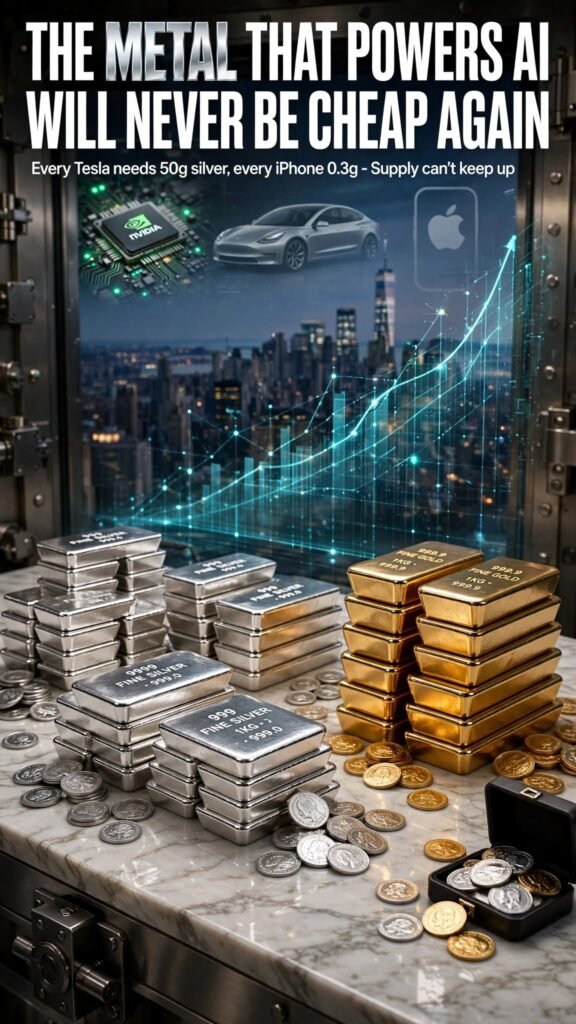
Silver possesses the highest electrical and thermal conductivity of all metals, making it irreplaceable in high-performance computing, AI microprocessors, electric vehicles (EVs), and solar panels. Every EV requires approximately 50 grams of silver, while each smartphone contains roughly 0.3 grams. Because mining output cannot instantly scale to match exponential tech growth, physical silver faces an escalating structural supply deficit that fundamentally alters its market valuation.
1. The AI Computing Boom and Silver Consumption
Artificial Intelligence models require exponentially more processing power and energy throughput than traditional cloud architecture. Advanced microchips, semiconductor packaging, and high-density circuit boards depend on physical silver to conduct electric currents with minimal resistance and heat loss.
+-------------------------------------------------------------------------+
|                INDUSTRIAL SILVER DEMAND PER UNIT METRIC                 |
+-------------------------------------------------------------------------+
|  APPLICATION                        |  APPROX. SILVER REQUIREMENT      |
|  - Electric Vehicle (e.g., Tesla)   |  ~50 Grams per Vehicle            |
|  - Smartphone (e.g., iPhone)        |  ~0.3 Grams per Unit              |
|  - AI Server / GPU Cluster          |  High-Density Multi-Gram Arrays   |
|  - Photovoltaic Solar Panel         |  ~20 Grams per Panel              |
+-------------------------------------------------------------------------+
As hyper-scaler tech corporations construct massive AI infrastructure facilities across North America and Asia, physical silver is being consumed at an unprecedented pace. Unlike silver held in financial vaults, industrial silver used in micro-components is rarely recycled due to high recovery costs, removing millions of ounces permanently from above-ground supply.
2. The Mining Bottleneck: Why Supply Can’t Catch Up
A common misconception among market participants is that higher silver prices will instantly trigger higher mine production. In reality, over 75% of global silver is mined as a secondary byproduct during the extraction of copper, lead, and zinc.
+-------------------------------------------------------------------------+
|                   THE SILVER BYPRODUCT BOTTLENECK                      |
+-------------------------------------------------------------------------+
|  Primary Silver Mines: ~25% of Global Mine Supply                       |
|  Byproduct Mining (Copper/Lead/Zinc): ~75% of Global Mine Supply        |
|  Result: Higher silver prices DO NOT automatically increase extraction! |
+-------------------------------------------------------------------------+
Because mining operations cannot simply expand output without multi-billion-dollar capital expenditures and decade-long permitting processes, global mine supply remains essentially inelastic. Industrial buyers must compete directly with sovereign vaults and private investors for existing physical inventory.
💡 Strategic Action Step:
Want to understand how private investors can position their portfolios ahead of institutional supply shortages?
👉 Download the Free 2026 Precious Metals Insider Guide HERE
3. Paper Futures vs. Physical Delivery Realities
While paper futures exchanges trade billions of ounces in synthetic silver contracts daily, commercial manufacturers cannot build microchips or electric vehicles with paper promises. When supply chains tighten, industrial buyers demand physical delivery at regional refineries.
This growing divergence between paper futures prices and physical spot premiums is forcing institutional capital out of unallocated paper claims and into direct physical ownership.
+-------------------------------------------------------------------------+
|                     PAPER CLAIMS VS. PHYSICAL ASSETS                    |
+-------------------------------------------------------------------------+
|  PAPER DERIVATIVES (ETFs/Futures)   |  PHYSICAL ALLOCATED BULLION       |
|  - Counterparty Liability           |  - Direct Legal Title             |
|  - Cash-Settlement Clauses          |  - Unencumbered Hard Asset        |
|  - Leveraged Synthetic Supply       |  - Strictly Finite Element        |
+-------------------------------------------------------------------------+
💡 Protect Your Retirement:
Discover how to rollover an existing 401(k) or IRA into physical, allocated silver and gold storage with complete tax compliance.
4. The Sovereign Asset Shift: Protecting Wealth in a Tech-Driven Era
As physical commodities become strategic geopolitical assets, smart-money investors and proactive retirement planners are reallocating a portion of their wealth out of vulnerable paper instruments and into allocated bullion.
Holding physical silver combines long-term industrial growth exposure with sovereign wealth protection, creating a double-engine hedge against currency dilution and supply chain dislocation.
💡 Take Control of Your Wealth:
Equip yourself with comprehensive insights on silver supply metrics, tax-free rollover options, and segregated vaulting solutions.
The technology driving the next economic decade—AI, electric mobility, and renewable power—cannot function without physical silver. With supply structurally constrained and industrial demand accelerating, physical silver is transitioning from a overlooked commodity into an essential strategic asset.
Are rising inflation, national debt, and market volatility quietly eroding your retirement savings? While millions of investors rely solely on paper stocks and mutual funds, central banks and institutional investors are quietly hoarding physical precious metals at record levels.
Holding physical gold and silver inside a Self-Directed IRA (SDIRA) offers the ultimate financial insurance. However, navigating the precious metals industry requires avoiding hidden fees, aggressive sales reps, and risky “home storage” traps. This comprehensive guide breaks down everything you need to know before investing a single dollar.
Many investors mistakenly believe that buying a Gold ETF [Exchange-Traded Fund: paper contracts that track spot prices] is the same as owning real gold.
Paper Gold (ETFs): Subject to counterparty risk, management fees, and market manipulation. You do not own physical metal.
Physical Bullion: Tangible gold (.995+ purity) and silver (.999+ purity) stored safely in an IRS-approved, secure depository (such as Brink’s or Delaware Depository).
2. The 7-Point Dealer Due Diligence Audit
Before transferring your retirement funds to any precious metals dealer, verify these seven crucial standards:
BBB & BCA History: Look for an A+ rating with zero unresolved consumer complaints.
Fee Transparency: Demand a clear, written breakdown of setup fees, annual storage costs, and administrative fees upfront.
No Collectible Coin Traps: Avoid dealers pushing high-markup “numismatic” or collectible coins. Stick to IRS-approved bullion coins and bars.
Guaranteed Buy-Back Policy: Ensure the dealer offers a fair, transparent liquidation process when you are ready to take distributions.
Segregated Vault Storage: Verify your physical coins and bars are kept in a private, designated container in your name.
No “Home Storage” Scams: Storing IRA-funded precious metals in your home safe is illegal under IRS rules and incurs severe penalties.
Educational Approach: Choose companies that offer 1-on-1 education rather than high-pressure sales calls.
3. How to Execute a 100% Tax-Free 401(k) Rollover
Moving your money into physical gold and silver does not trigger a taxable event if done correctly via a direct trustee-to-trustee rollover.
[ Existing 401(k) / IRA ] ──► (Direct Transfer) ──► [ Self-Directed IRA ] ──► [ IRS Depository Vault ]
Augusta Precious Metals: Renowned for their Harvard-trained economic team and zero-complaint record. They prioritize deep investor education before opening an account.
Birch Gold Group: Known as “The Precious Metals Specialist,” offering a predictable flat-fee structure and an excellent path for liberty-minded investors seeking inflation hedges.
5. Frequently Asked Questions (FAQ)
Can I store my Gold IRA metals at home?
No. The IRS strictly mandates that all IRA-held physical precious metals must be stored in an approved, insured non-bank depository.
What is the minimum amount required to start a Gold IRA?
The geopolitical landscape underwent a tectonic shift following the high-stakes summit in Washington between U.S. President Donald Trump and Chinese President Xi Jinping. While headlines focused on temporary trade truces and technology guardrails, macro analysts and institutional investors zeroed in on the true underlying flashpoint: critical minerals and strategic precious metals.
As Beijing leverages its near-monopoly on rare earths and industrial inputs, and Washington moves aggressively with initiative measures to stockpile domestic critical reserves, the weaponization of natural resources is no longer a future risk—it is our current economic reality.
What is the outcome of the Trump-Xi summit regarding critical minerals and precious metals?
The Trump-Xi summit highlighted a fragile geopolitical truce where critical minerals and strategic metals (including silver, gold, and rare earth elements) serve as primary economic leverage. China’s dominant control over mineral processing and industrial refined metals has forced Western powers to push for independent strategic stockpiles. This growing resource nationalism, combined with central bank reserve diversification away from paper debt, underscores the necessity of holding unencumbered physical precious metals as sovereign wealth protection.
1. The Weaponization of Strategic Supply Chains
For decades, global markets operated under the assumption of seamless cross-border supply chains. That era has officially ended. The recent summit negotiations made it abundantly clear that natural resources—specifically silver, gold, platinum group metals, and critical rare earths—are being utilized as monetary and economic weapons.
China currently commands roughly 70% of global rare-earth extraction and up to 90% of magnet and refined alloy production. In response, Western nations are rushing to establish strategic mineral stockpiles to shield domestic technology, defense, and energy sectors from catastrophic supply chokepoints.
When industrial powerhouses compete for finite physical elements, retail paper claims (ETFs and unallocated accounts) face severe counterparty risk. The physical asset itself becomes the only guaranteed title of ownership.
2. Central Bank Reserve Shifts: From Paper Debt to Hard Assets
Beyond industrial application, a quiet monetary revolution is taking place. Central banks globally are systematically reducing their exposure to sovereign paper debt in favor of physical bullion.
With gold reserves now matching or outpacing traditional treasury holdings in key sovereign portfolios, central banks are signaling a return to sound money principles. As fiat currencies dilute through continuous debt monetization, physical gold and silver represent true unencumbered reserve assets that carry zero credit risk.
💡 Strategic Action Step:
Want to learn how private investors can structure an allocated, physical bullion portfolio completely outside the banking system?
While gold anchors sovereign monetary reserves, silver sits at the intersection of monetary trust and industrial demand. Advanced technologies—ranging from artificial intelligence data infrastructure to electric vehicles and solar arrays—require massive quantities of high-purity silver.
Because over 75% of silver is mined as a secondary byproduct of copper, lead, and zinc extraction, mining operations cannot simply expand output in response to price spikes. This structural bottleneck makes physical silver one of the most asymmetric hard assets available today.
💡 Protect Your Retirement:
Learn how to execute a tax-free, penalty-free rollover from your existing 401(k) or IRA into physical, segregated gold and silver vault storage.
During high-stakes trade disputes and economic re-alignments, the paper-to-physical ratio in precious metals markets creates unprecedented volatility. Paper futures contracts allow financial institutions to trade trillions in “synthetic” metal, but when supply lines freeze, only physical delivery matters.
+-------------------------------------------------------------------------+
|                    PAPER CLAIMS VS. HARD BULLION                        |
+-------------------------------------------------------------------------+
|  PAPER METALS (ETFs / Futures)   |  PHYSICAL ALLOCATED VAULTING         |
|  - Counterparty / Broker Risk    |  - Direct Legal Ownership            |
|  - Subject to Cash Settlement   |  - Out of Banking System Control     |
|  - Unlimited Synthetic Supply   |  - Strictly Finite Physical Supply   |
+-------------------------------------------------------------------------+
To achieve true financial sovereignty, investors are turning toward private, allocated, and segregated vaulting solutions where physical bars are registered directly in the client’s legal name.
💡 Take Control of Your Wealth:
Equip yourself with institutional-grade research on precious metals allocation, private vaulting, and sovereign asset protection.
The modern global economy runs on a critical, irreplaceable foundation: physical silver. While mainstream financial media remains preoccupied with paper debt instruments, stock market earnings calls, and digital currency speculation, an unprecedented structural shift is taking place behind closed doors. Silicon Valley powerhouses, automotive leaders, and green-energy conglomerates are competing for the exact same finite pool of physical silver that retail investors rely on for wealth preservation.
                           THE PHYSICAL SILVER SQUEEZE

   +---------------------------------+   +---------------------------------+
   |      EXPANDING TECH DEMAND      |   |    STAGNANT MINE PRODUCTION     |
   | • AI Data Centers & Microchips  |   | • 75%+ Mine Output as Byproduct |
   | • EV Battery & Electronics      |   | • Depleting Above-Ground Vaults |
   | • Next-Gen Solar Infrastructure |   | • 6 Consecutive Years Deficit   |
   +---------------------------------+   +---------------------------------+
                    \                                 /
                     \---> STRUCTURAL MARKET TENSION <---/
To understand why tech titans are consuming massive quantities of physical silver, one must examine elemental physics. Silver is the single most electrically conductive, thermally conductive, and optically reflective metal on Earth. In high-stakes technological applications where component failure or energy loss is intolerable, silver is non-negotiable.
1. Artificial Intelligence and Computing Infrastructure
The expansion of Artificial Intelligence requires unprecedented computational power. Microprocessors, high-density server racks, and data center cooling frameworks depend on silver-coated contacts and high-purity silver alloys to maintain efficiency under high thermal loads. As tech giants scale AI capabilities globally, their structural requirement for silver grows exponentially.
2. Automotive Electrification
Traditional internal combustion engine vehicles contain modest amounts of silver for basic electrical relays. In contrast, modern Electric Vehicles (EVs) utilize significantly higher quantities of silver per chassis. From battery management systems (BMS) and power electronics to autonomous sensor suites and fast-charging interfaces, silver serves as the conductive nervous system of modern transportation.
3. Photovoltaic Solar Power
The global transition toward renewable energy has converted the solar industry into the largest single industrial consumer of silver. High-efficiency photovoltaic (PV) solar cells—specifically Tunnel Oxide Passivated Contact (TOPCon) and Heterojunction (HJT) technologies—utilize silver paste screen-printed directly onto silicon wafers to conduct electricity.
The fundamental flaw in the paper silver market is the assumption that physical supply can expand instantly to meet rising industrial consumption. In reality, the silver market has entered an unprecedented era of sustained structural deficits.
Over three-quarters of global silver mine production is recovered as a secondary byproduct from copper, lead, zinc, and gold mines. Because silver output depends directly on the mining economics of primary base metals, higher silver prices alone do not trigger an immediate increase in global silver mining output. Opening a new primary silver mine typically requires 7 to 10 years of environmental permitting, capital raising, and geological development.
Depleting Above-Ground Inventories
When annual demand exceeds annual supply, the difference must be supplied from existing above-ground stockpiles—specifically exchange vaults (such as COMEX and LBMA) and private depositories. Over the past six consecutive years, hundreds of millions of ounces of physical silver have been permanently removed from vault reserves to meet manufacturing needs.
Section 3: Industrial Consumption vs. Monetary Stacking
A critical difference between gold and silver lies in their ultimate consumption lifecycle:
Gold: Nearly all the gold ever mined in human history still exists in visible, accessible form—as central bank bullion bars, jewelry, or private holdings. Gold is rarely consumed in industrial processes.
Silver: Once silver is processed into microchips, solar panels, medical devices, or automotive components, it is dispersed across billions of consumer products in minute quantities. Economically, recovering microscopic quantities of silver from recycled e-waste is far more expensive than purchasing raw bullion, leading to the permanent industrial loss of millions of ounces each year.
   GOLD VS. SILVER CONSUMPTION DYNAMICS
   +-----------------------------------------------------------------+
   | GOLD   | 90%+ Preserved in Vaults, Bullion, and Fine Jewelry   |
   +-----------------------------------------------------------------+
   | SILVER | 60% Permanently Consumed / Dispersed in High-Tech Waste |
   +-----------------------------------------------------------------+
Section 4: Strategic Asset Protection for Individual Investors
As industrial conglomerates buy up physical supply chains, individual investors face a tightening window to secure unencumbered physical metal.
1. Paper Claims vs. Physical Title
Many retail investors attempt to gain silver exposure through paper exchange-traded funds (ETFs) or unallocated pool accounts. However, during periods of acute physical shortages, paper claims face severe counterparty risks, potential cash settlements, and trading halts. Holding allocated, physical silver bars or coins stored under your direct legal title removes third-party liability entirely.
2. Vaulting and Physical Security
To protect physical holdings from systemic disruption or local security risks, investors utilize allocated, non-bank vault depositories. Professional storage facilities (such as Brink’s, Loomis, or Texas Depository) provide fully insured, segregated storage where specific serial-numbered bullion bars remain your exclusive legal property, accessible or withdrawable at your command.
Section 5: Frequently Asked Questions
Q1: Why do tech companies like Tesla, Apple, and Nvidia use silver instead of cheaper metals like copper? MORE INFO HERE: https://pricedoutgoldhedge.lovable.app/
A: While copper is a good conductor, silver possesses superior electrical conductivity, higher thermal resistance, and superior resistance to oxidation. In high-performance microchips, solar cells, and automotive safety systems, using copper instead of silver leads to energy loss, overheating, and higher component failure rates.
Q2: What is the Gold-to-Silver Ratio (GSR), and why does it matter?
A: The Gold-to-Silver Ratio measures how many ounces of silver are required to purchase one single ounce of gold. Historically, the ratio averaged 15:1 to 20:1 throughout monetary history, and modern geological abundance in the Earth’s crust is roughly 8:1. When the ratio trades at elevated levels (e.g., 80:1 or 90:1), many analysts view silver as significantly undervalued relative to gold.
Q3: How much physical silver should an individual stack for portfolio protection?
A: Wealth preservation strategies generally suggest allocating between 5% and 15% of an overall financial portfolio to physical precious metals, balancing lower-volatility gold with higher-upside industrial silver.
For the first time since 1996, the global monetary landscape has experienced a seismic structural shift. Official central bank reserve data confirms that physical gold now represents 27% of global reserves, outstripping U.S. Treasury holdings, which have dropped to 22%.
Following the mid-1990s, globalization and dollar dominance incentivized foreign nations to park excess trade reserves in interest-bearing U.S. debt. However, the compounding effect of persistent fiscal deficits, monetary expansion, and escalating inflation risks has altered the risk-reward calculus for global central bankers.
2. The Four Pillars of the Physical Shift
1. Hedge Against Systemic Inflation: Paper fixed-income returns struggle to preserve real purchasing power during sustained inflationary waves.
2. Permanent Wealth Preservation: Physical bullion carries no counterparty or issuer default risk, serving as an absolute monetary anchor.
3. Accelerating Global Demand: Central bank buying, led by institutions like the People’s Bank of China and the Reserve Bank of India, has established a consistent structural floor under bullion prices.
4. Natural Supply Limits: Unlike digital credit or sovereign bond issuances, physical gold cannot be created at will.
3. What This Means for Private Wealth
The central bank shift from paper debt to allocated bullion underscores a fundamental rule of wealth protection: When financial uncertainty rises, tangible unencumbered assets outperform paper promises. Securing allocated gold in private, non-bank vaulting remains the gold standard for long-term capital protection.