

If you are navigating the turbulent economic waters of mid-2026, you are witnessing a phenomenon that hasn’t occurred in generations. Traditional paper retirement accounts are fracturing under the weight of persistent currency devaluation, global tariff wars, and multi-trillion-dollar sovereign debt expansions. Everyday retail investors are desperately chasing overvalued tech stocks and highly speculative digital tokens. Yet, sitting quietly right under the market’s nose is what prominent commodities analysts are calling the single most mispriced real asset of the decade: Physical Silver.
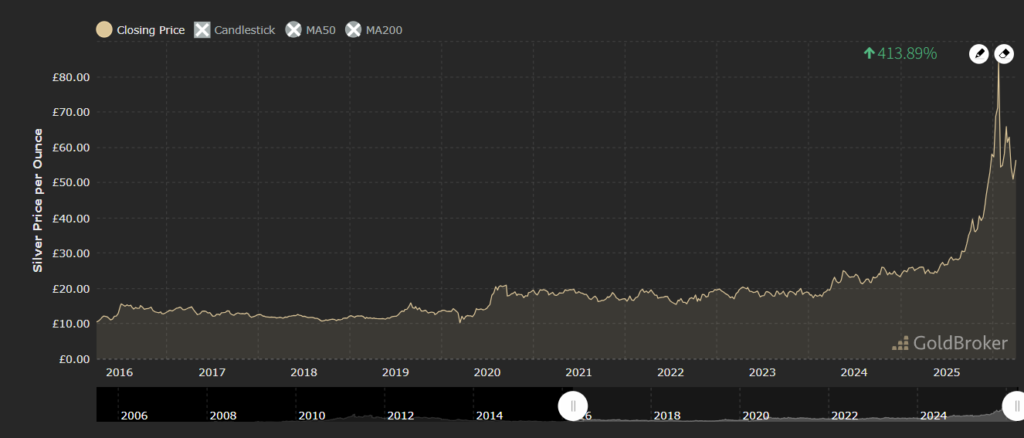
Last year, silver shocked the mainstream financial world by gaining over 130%, climbing from its quiet $29 baseline up to a staggering technical peak near $121 in January 2026. While the paper derivative markets have since engineered a textbook price consolidation back toward the $70–$80 range to shake out weak retail hands, the hard physical data tells an entirely different story. The underlying structural drivers haven’t weakened; in fact, they have fundamentally accelerated.
For anyone looking 6 months ahead into the tail-end of 2026 and preparing for the dawn of 2027, the window to act is tightening. This comprehensive deep-dive exposes the multi-layered supply crunch powering this white metal, breaks down the historic compression of the gold-to-silver ratio, and explains how you can securely protect your hard-earned assets before a severe physical inventory squeeze locks individual buyers out entirely.
🛡️ Retirement Strategy Alert
Do not leave your financial destiny exposed to systemic bank bail-ins or paper market liquidations. If you have an unmanaged, legacy 401(k) or conventional employer IRA, you can legally transition those paper positions into real, physical vault-secured silver bullion completely tax-free and penalty-free.
👉 Secure Your Portfolio Strategy: Claim Your Free 2026 Birch Gold Silver Investment Guide Today
1. Introduction: The Irreversible Fracture of the Paper System
For decades, the global financial system has trained savers to store their net worth exclusively within the digital banking grid. We are told that a diversified blend of mutual funds, corporate bonds, and online brokerage accounts will naturally shield our families from long-term inflation. However, in mid-2026, that narrative has completely broken down.
When you leave your entire life savings inside a conventional bank or stock brokerage account, your wealth does not actually exist as a physical item. It exists purely as an unbacked electronic entry. You are exposed to compounding counterparty risk—meaning your family’s financial stability relies entirely on the solvency of corporate executives, the stability of the digital internet grid, and the monetary whims of central banks that print money out of thin air to fund endless debts.
Physical precious metals represent the ultimate defense against this vulnerability. When you hold investment-grade bullion, you hold an asset with zero counterparty risk. It cannot go bankrupt, cannot be deleted by a regional grid failure, and cannot be diluted by legislative spending packages. While paper cash continues to buy less food, fuel, and land with each passing month, physical metal stands firm and tall, preserving its purchasing power exactly as it has done for thousands of years.

2. The 2026 Micro Analysis: Industrial Dominance vs. Inelastic Mining Supply
To understand why silver is completely mispriced at current levels, one must look past speculative Wall Street headlines and study the raw physical manufacturing metrics of 2026. Silver is unique because it is a dual-nature asset. It is a historic monetary store of value, but it is also an irreplaceable, highly conductive industrial commodity critical to the global technology framework.
The Non-Discretionary Industrial Squeeze:
- The AI Data Center Boom: The rapid global deployment of hyperscale artificial intelligence data networks has rewritten the demand metrics for precious metals. High-performance computing clusters and advanced semiconductor arrays require massive quantities of silver for precision contacts, microprocessors, and thermal management systems, consuming an estimated 2 to 5 kilograms of silver per megawatt of computing capacity.
- The Solar Grid Photovoltaic Squeeze: The shift toward renewable energy infrastructure has moved from an ideological goal to an industrial mandate. Solar panel manufacturing now devours more than 25% of the total annual global silver supply. Advanced photovoltaic cell architectures require up to 30% more silver paste per panel than legacy designs to maximize current collection, making solar the single fastest-growing industrial application in the world.
- The Autonomous & EV Automotive Shift: Modern electric vehicles and autonomous cars are rolling supercomputers. They require heavy silver loads for complex sensor packages, LiDAR arrays, safety radar, and battery management nodes. The automotive sector alone is on track to consume over 55 million ounces of silver annually before the end of the decade.
The Problem of Inelastic Mine Supply
Here is the catch that Wall Street fails to grasp: you cannot simply print more silver when the price spikes. Over 70% of all silver mine production is pulled from the earth as a incidental by-product of mining base metals like copper, lead, and zinc. Primary silver mines are exceptionally rare, and launching a brand-new mining operation takes an average of 7 to 10 years due to environmental permitting, compliance regulations, and massive capital expenditure requirements. Because mine output is completely rigid, the global silver market is trapped in an intense, structural physical deficit of 160 million to 200 million ounces per year. Inventories in major wholesale hubs like London have reached historic lows, with lease rates spiking dramatically as industrial buyers scramble to secure real, physical deliveries.
📈 Market Update Brief
As industrial shortages collide with massive central bank gold accumulations, physical bullion bars are moving out of public circulation at a record pace. If you are not purchasing yet, at least educate yourself on the exact mechanics of real asset preservation.
👉 Access the Birch Gold Group Zero-Cost Physical Bullion Educational Framework
3. Key Considerations: The Gold-to-Silver Ratio Compression
For long-term investors looking to maximize their upside over the next 6 months heading into 2027, the most compelling mathematical argument for silver lies within the historical Gold-to-Silver Ratio. This metric calculates exactly how many ounces of physical silver it takes to purchase a single ounce of physical gold.

Over the course of the 20th and 21st centuries, the ratio has held a long-run historical average of around 60-to-1 or 65-to-1. However, during market extremes, this ratio stretches and compresses like a rubber band:
- In early 2025, the ratio stretched to an extreme, deeply distorted reading of 105-to-1, rendering silver cheaper relative to gold than at almost any point in modern history.
- As the physical supply deficits accelerated through late last year, the ratio began to compress aggressively, dropping toward the mid-50s as silver’s net percentage gains dramatically outpaced gold.
When Bank of America’s commodities research division analyzed this mean-reversion cycle, they built their core macro projections around this exact ratio compression. If gold holds its current high-ground consolidation levels while the ratio continues its historical reversion toward its long-run average, silver is mathematically positioned to target $135 per ounce. In an aggressive squeeze scenario matching the historical 19th-century baseline of 15-to-1, targets scale well over $300 per ounce. This extreme mathematical asymmetry is precisely why elite value investors identify the physical white metal as a heavily mispriced asset class.
4. Step-by-Step Guide: How to Secure Investment-Grade Bullion
When you decide to exit the digital paper loop and establish a permanent allocation in real assets, you must execute your strategy using a systematic, secure protocol to protect yourself from hidden institutional fees and predatory counterparty traps.
[Determine Allocation] ──► [Select Low-Premium Bars] ──► [Choose Insured Vaulting] ──► [Verify Purity (.999)]
Step 1: Filter Out Collectible Numismatic Traps
If your primary goal is wealth preservation, inflation insulation, or retirement protection, you should focus your capital strictly on investment-grade bullion. High-pressure television commercials and predatory retail storefronts frequently attempt to push “rare coins,” “limited-edition proofs,” or “graded numismatics” at massive, artificial retail markups over the spot price. These collectible markups are incredibly difficult to recover when you decide to liquidate. Stick to raw weight, high-purity bars where you get the maximum amount of actual physical metal for your dollar.
Step 2: Focus on Low-Premium Weight Tiers
To optimize your investment, it is highly efficient to purchase silver bars in standardized, globally recognized weight tiers, such as 10-ounce, 100-ounce, or 1-kilogram configurations. Larger cast or minted bars carry substantially lower fabrication premiums over the raw spot price compared to small 1-ounce fractional rounds, allowing you to maximize your total physical ounce count at checkout. Ensure every bar you acquire is stamped with its exact weight, certified .999+ fine silver purity, and carries the official hallmark of an LBMA-approved refiner (such as Valcambi, Royal Canadian Mint, or Johnson Matthey).
Step 3: Utilize Insured, Non-Bank Vault Storage
For smaller personal allocations, storing your bullion inside a heavy, bolted, fireproof home safe can be a practical option. However, for substantial wealth allocations or retirement transfers, home storage introduces personal security concerns and eliminates your ability to liquidate instantly.
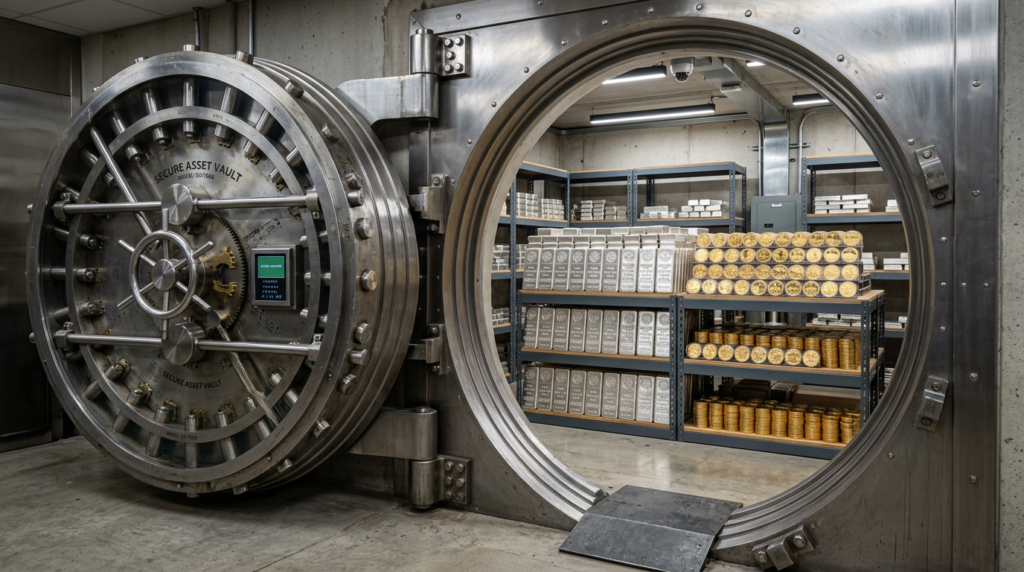
The gold standard for corporate-grade asset safety is fully allocated, segregated storage inside an independent, non-bank depository vault (such as Brink’s or Delaware Depository). Avoid keeping your core physical wealth inside a traditional commercial bank safe deposit box; safe deposit boxes are completely unbacked by federal FDIC insurance policies and are subject to strict regulatory banking asset-freeze laws during a major credit or systemic banking holiday.
5. Expert Tips: Executing a Tax-Free 401(k) Rollover
You do not need to liquidate your personal personal cash savings or checking accounts to secure physical protection before the 2027 market shift. If you hold an unmanaged, legacy 401(k), 403(b), or traditional IRA from a previous employer, you can execute a direct, custodian-to-custodian transfer into a specialized Self-Directed Precious Metals IRA.
Because the capital moves directly between the institutional account administrators, the entire structural transition is executed 100% tax-free and carries zero early withdrawal penalties. Your retirement foundation preserves its tax-deferred or Roth tax-advantaged status, but your foundational capital is safely converted from volatile, paper-backed digital mutual funds into real, physical, serialized bullion bars held securely under your direct legal title within an audited, high-security depository vault.
6. Common Mistakes Online Bullion Buyers Must Avoid
- Relying on “Unallocated” or “Paper” Silver Products: Many retail investors think they own silver because they bought shares in a standard silver ETF or an online unallocated pool account. In an unallocated system, the broker or dealer uses your money to back their corporate balance sheet, and you hold nothing but a digital promissory note. If the firm faces a sudden liquidity crisis or bankruptcy, you are classified as an unsecured creditor, and you cannot demand physical delivery of your metal. Insist exclusively on physical, fully allocated ownership.
- Funding Purchases with Consumer Credit Cards: Reputable online clearing houses charge a mandatory 3% to 4% merchant surcharge on all purchases funded via personal credit cards. To bypass these unnecessary premium markups, always execute your bullion purchases via secure bank wires or direct ACH bank transfers to keep your acquisition costs as close to the baseline spot price as possible.
7. Conclusion: The 6-Month Window Ahead of 2027
The economic landscape does not stand still for casual observers. As we look across the remaining months of 2026 and prepare for the structural shifts of 2027, the data points to a massive convergence. The physical silver supply deficit is deepening, industrial demand from AI and solar grids is scaling to unprecedented levels, and central banks are actively dismantling their reliance on unbacked paper systems.
The paper market’s temporary price consolidation is a classic gift for those who understand macro fundamentals—providing an optimal, high-value entry window to secure tangible assets while they remain heavily mispriced relative to the broader market. If you are not ready to pull the trigger on a physical purchase today, the absolute minimum requirement for your family’s asset safety is to educate yourself on the mechanics of physical wealth preservation before the next major supply shock hits the retail exchanges.
🚨 Final Wealth Protection Check
Do not wait for a systemic bank disruption or an aggressive physical supply chain freeze to force your hand. Partner with the industry’s premier real-asset onboarding team, bypass predatory retail broker fees, and lock in your permanent financial protection today.
🔎 Frequently Asked Questions (AEO Search Optimization Engine)
Q: Why is silver considered an essential industrial asset compared to gold?
A: Gold functions primarily as a monetary asset, a central bank reserve, and a direct wealth store with very limited industrial consumption. Silver, by contrast, possesses the highest electrical conductivity, thermal conductivity, and light reflectivity of any element on earth. It is an absolute, non-discretionary industrial component in advanced electronics, 5G cellular infrastructure, autonomous vehicles, and solar photovoltaic green energy grids, making its valuation highly sensitive to global technology manufacturing cycles.
Q: What is the legal difference between allocated and unallocated bullion storage?
A: In an unallocated storage structure, the investor does not own specific, physical pieces of metal; instead, they own a generic financial claim against a dealer’s total unsegregated pool inventory, leaving the asset exposed to the firm’s corporate bankruptcy or default risks. In a fully allocated and segregated storage structure, specific physical silver bars stamped with unique refiner serial numbers are legally titled to the investor alone and physically separated inside an audited depository vault, completely isolating the asset from any counterparty or institutional liability.
Q: Can I transfer my active, current employer 401(k) into a physical silver IRA?
A: Generally, no. Under current IRS guidelines, an active 401(k) plan with your current employer cannot be rolled over into a Self-Directed Precious Metals IRA unless the specific plan corporate guidelines contain a designated “in-service distribution” clause (typically available to employees over the age of $59\frac{1}{2}$). However, any legacy, inactive 401(k), 403(b), or standard traditional/Roth IRA associated with a previous employer or past business venture is 100% eligible for an immediate, tax-free, penalty-free structural transfer into physical bullion bars.

Leave a Reply