
The modern digital economy relies on a critical, irreplaceable foundation: physical silver. While mainstream financial media remains preoccupied with tech earnings and digital currency speculation, an unprecedented structural shift is taking place inside global supply chains. Silicon Valley powerhouses, automotive leaders, and green-energy conglomerates are competing for the exact same finite pool of physical silver that retail investors rely on for wealth preservation.
From the high-density chips powering artificial intelligence (AI) data centers to the photovoltaic arrays in modern solar grids, industrial demand for physical silver has detached from traditional mining cycles. As mining production hits structural ceilings, the global market has entered an irreversible supply deficit.
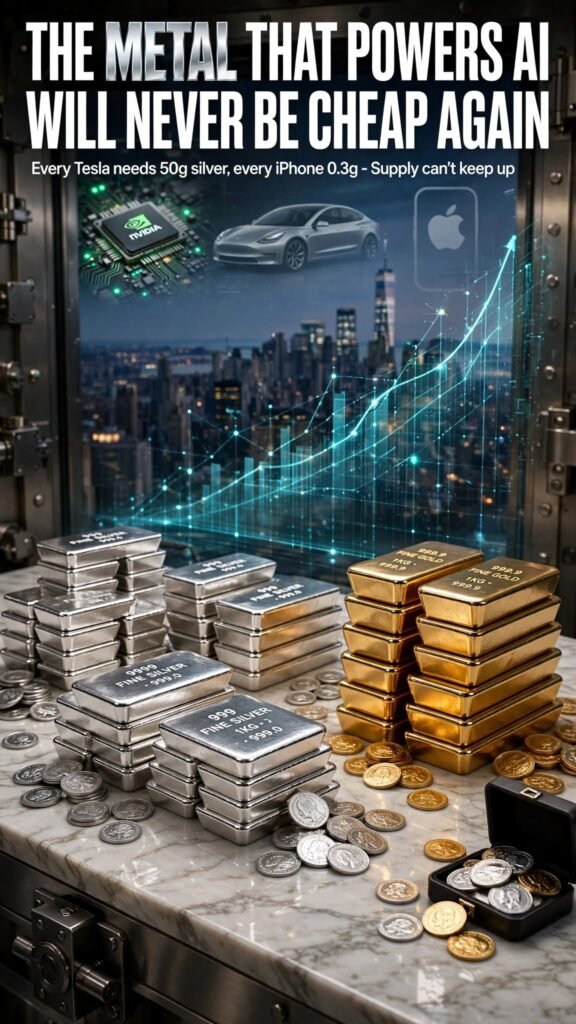
Why is silver critical for AI technology and modern electronics?
Silver possesses the highest electrical and thermal conductivity of all metals, making it irreplaceable in high-performance computing, AI microprocessors, electric vehicles (EVs), and solar panels. Every EV requires approximately 50 grams of silver, while each smartphone contains roughly 0.3 grams. Because mining output cannot instantly scale to match exponential tech growth, physical silver faces an escalating structural supply deficit that fundamentally alters its market valuation.
1. The AI Computing Boom and Silver Consumption
Artificial Intelligence models require exponentially more processing power and energy throughput than traditional cloud architecture. Advanced microchips, semiconductor packaging, and high-density circuit boards depend on physical silver to conduct electric currents with minimal resistance and heat loss.
+-------------------------------------------------------------------------+
|                INDUSTRIAL SILVER DEMAND PER UNIT METRIC                 |
+-------------------------------------------------------------------------+
|  APPLICATION                        |  APPROX. SILVER REQUIREMENT      |
|  - Electric Vehicle (e.g., Tesla)   |  ~50 Grams per Vehicle            |
|  - Smartphone (e.g., iPhone)        |  ~0.3 Grams per Unit              |
|  - AI Server / GPU Cluster          |  High-Density Multi-Gram Arrays   |
|  - Photovoltaic Solar Panel         |  ~20 Grams per Panel              |
+-------------------------------------------------------------------------+
As hyper-scaler tech corporations construct massive AI infrastructure facilities across North America and Asia, physical silver is being consumed at an unprecedented pace. Unlike silver held in financial vaults, industrial silver used in micro-components is rarely recycled due to high recovery costs, removing millions of ounces permanently from above-ground supply.
2. The Mining Bottleneck: Why Supply Can’t Catch Up
A common misconception among market participants is that higher silver prices will instantly trigger higher mine production. In reality, over 75% of global silver is mined as a secondary byproduct during the extraction of copper, lead, and zinc.
+-------------------------------------------------------------------------+
|                   THE SILVER BYPRODUCT BOTTLENECK                      |
+-------------------------------------------------------------------------+
|  Primary Silver Mines: ~25% of Global Mine Supply                       |
|  Byproduct Mining (Copper/Lead/Zinc): ~75% of Global Mine Supply        |
|  Result: Higher silver prices DO NOT automatically increase extraction! |
+-------------------------------------------------------------------------+
Because mining operations cannot simply expand output without multi-billion-dollar capital expenditures and decade-long permitting processes, global mine supply remains essentially inelastic. Industrial buyers must compete directly with sovereign vaults and private investors for existing physical inventory.
💡 Strategic Action Step:
Want to understand how private investors can position their portfolios ahead of institutional supply shortages?
👉 Download the Free 2026 Precious Metals Insider Guide HERE
3. Paper Futures vs. Physical Delivery Realities
While paper futures exchanges trade billions of ounces in synthetic silver contracts daily, commercial manufacturers cannot build microchips or electric vehicles with paper promises. When supply chains tighten, industrial buyers demand physical delivery at regional refineries.
This growing divergence between paper futures prices and physical spot premiums is forcing institutional capital out of unallocated paper claims and into direct physical ownership.
+-------------------------------------------------------------------------+
|                     PAPER CLAIMS VS. PHYSICAL ASSETS                    |
+-------------------------------------------------------------------------+
|  PAPER DERIVATIVES (ETFs/Futures)   |  PHYSICAL ALLOCATED BULLION       |
|  - Counterparty Liability           |  - Direct Legal Title             |
|  - Cash-Settlement Clauses          |  - Unencumbered Hard Asset        |
|  - Leveraged Synthetic Supply       |  - Strictly Finite Element        |
+-------------------------------------------------------------------------+
💡 Protect Your Retirement:
Discover how to rollover an existing 401(k) or IRA into physical, allocated silver and gold storage with complete tax compliance.
4. The Sovereign Asset Shift: Protecting Wealth in a Tech-Driven Era
As physical commodities become strategic geopolitical assets, smart-money investors and proactive retirement planners are reallocating a portion of their wealth out of vulnerable paper instruments and into allocated bullion.
Holding physical silver combines long-term industrial growth exposure with sovereign wealth protection, creating a double-engine hedge against currency dilution and supply chain dislocation.
💡 Take Control of Your Wealth:
Equip yourself with comprehensive insights on silver supply metrics, tax-free rollover options, and segregated vaulting solutions.
Key Takeaway
The technology driving the next economic decade—AI, electric mobility, and renewable power—cannot function without physical silver. With supply structurally constrained and industrial demand accelerating, physical silver is transitioning from a overlooked commodity into an essential strategic asset.
Leave a Reply